Introduction
Person or Prompt?
Multifamily operators are automating faster than ever. The question is whether residents are on board.
AI in maintenance is past its pilot phase. It's the default playbook proven with faster response times, 24/7 coverage, and smarter routing. Rollout is accelerating across every portfolio size. The business case is clear. None of this is necessarily surpising.
But the metrics that justify automation aren't the same metrics residents use to evaluate service. Response time can be instant and still feel impersonal. Deflection rates can climb while satisfaction hovers at a mere 1-2 point percentage line.
In this study, half of all maintenance requests qualify as emergencies – and that's exactly where a critical gap emerges. Residents need to feel heard. How that moment balances AI and human intelligence carries more weight on the bottom line than you might think.
What the Data Shows

Independent research commissioned by HappyCo delivers the first comprehensive study of how AI interactions – chatbots and voice agents – shape the maintenance experience and how humans in the loop influence renewal intent. 299 multifamily residents make one thing clear: where AI belongs depends entirely on what's at stake.
The Full report
When Emergencies Call
If AI has a shot at winning the resident's heart, it loses it the moment maintenance shifts from routine to urgent. Only 30% feel comfortable using AI to report an emergency.
Water coming through the ceiling isn't a moment for chatbot triage – residents want to know someone understands the urgency and is mobilizing a response quickly.
When asked about common interactions with property management:
These aren't edge cases. Plumbing alone accounts for 36% of maintenance requests, followed by water damage (13%), and appliance failures (13%). Half of all issues reported (51%) qualified as emergencies. And the preference is overwhelming:
82%
Of all residents surveyed prefer human interaction first when an urgent maintenance issue arises
Even among the subset of residents surveyed who have used AI for maintenance before, 74% still prefer a human first in emergencies. Familiarity with AI doesn't change the calculus when the stakes are high.
“We had a pipe under the kitchen sink burst so we called to have it patched up then replaced. I was able to talk to a real person and get the situation handled quickly.”
But that doesn't mean residents disregard AI entirely. For the right situations, they see real value, especially when it means skipping hold music at midnight or getting a quick answer without tracking down the leasing office.
The 67% who are comfortable with AI for general questions aren't reluctant adopters. They genuinely appreciate the speed and accessibility.
“I prefer AI for quick, 24/7 responses, easy scheduling, and faster issue resolution without wait times.”
The Trust Pattern

Residents see the value in AI automation. But when it comes to preference, convenience isn't the only thing they're weighing.
Trust Isn’t Preference
More than half of survey respondents (56%) say they’d trust an AI-only system to handle a maintenance issue from start to finish. This finding suggests AI has cleared a basic credibility bar. But trust measures capability. Preference measures comfort. And they don't always align.
Even among residents who have used AI before for maintenance, the pattern holds across age groups, and technology comfort levels.
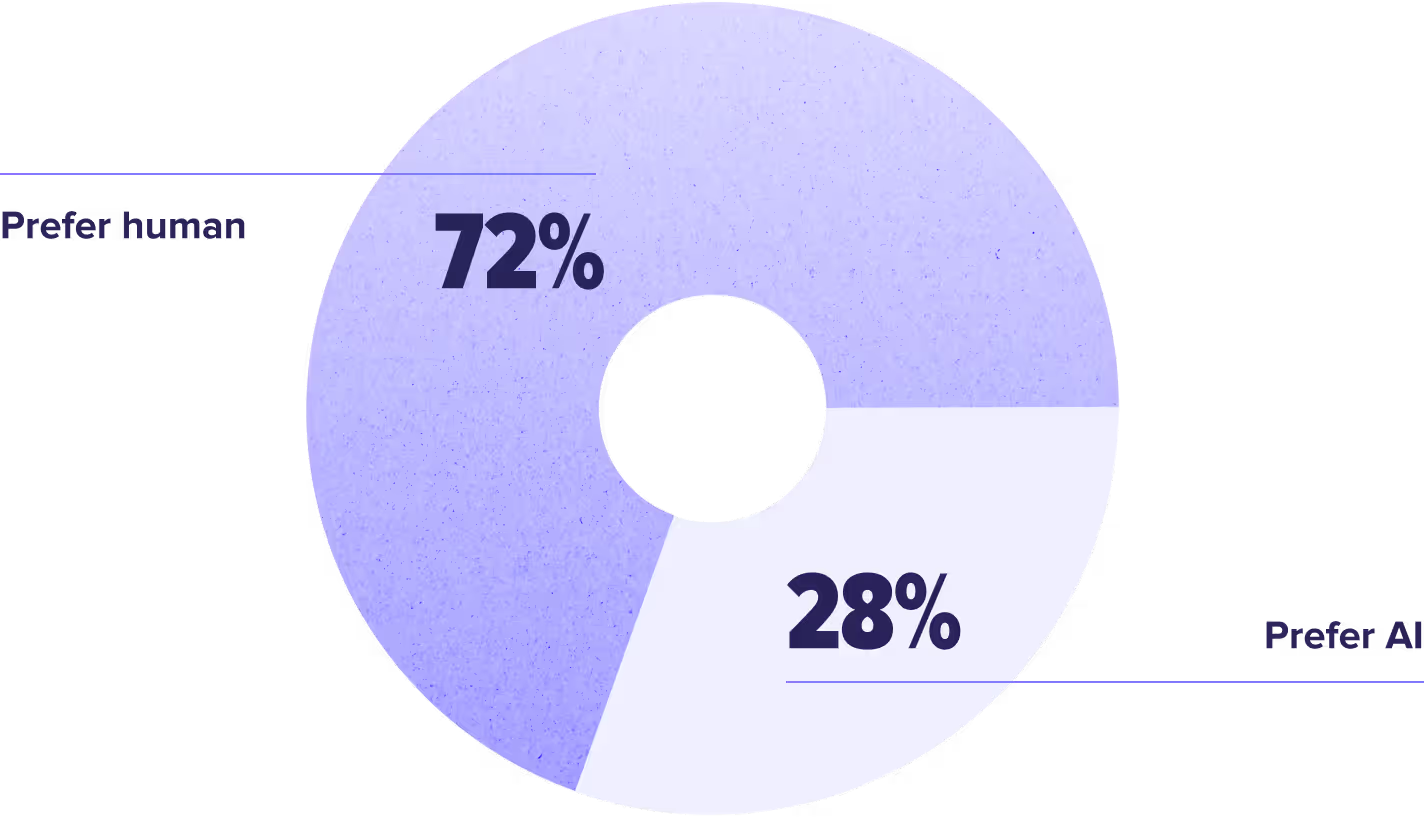
Not because AI isn't fast. Not because it isn't convenient. But because it can't offer what matters most: reassurance, adaptability, and the feeling that someone truly understands the urgency.
That said, the 28% who prefer AI aren't outliers. For some, the impersonal nature is the appeal, especially when AI removes the social friction entirely.
“It's easier on my wellbeing not having to talk to an actual person. It takes the stress and possible guilt of having something go wrong in the apartment. Even if what went wrong isn't my fault, it still helps having a neutral party to talk to.”
For the majority who prefer humans, it comes down to something AI can't easily replicate: dynamic troubleshooting. A maintenance coordinator who knows the property's systems and history can assess severity, identify root causes, and prioritize accordingly.
“The AI can have a set of preprogrammed questions which is pretty limited in conveying information, but with a real person – who knows their business – you can get more information from the questions they know to ask.”
Beyond the Script
The limitation residents identify – rigid scripts that miss the real issue – points to an opportunity. AI trained on actual service records, not generic decision trees, can detect root causes triggered by resident questions.
Where Satisfaction Splits
But when you look at individual process attributes – professionalism, scheduling, response speed – the scores are nearly identical whether residents interact with humans or AI, around 82% satisfaction. Tasks are completed either way, but the difference shows up in intensity. When asked how much the interaction improved overall satisfaction:
60%
Say humans significantly improved satisfaction
That 14-point percentage gap reveals something process metrics miss. AI holds its own on the mechanics – logging issues, routing requests, scheduling. But maintenance isn't just about fixing things. It's about how people feel while they wait.
A leaky faucet is annoying. A leaky faucet no one seems to care about? That's what sends someone searching for a new home on Zillow.
71%
Of residents say empathy or feeling heard is very important when dealing with maintenance issues
This isn't soft data. In hospitality, the service recovery paradox is well-documented: guests who experience a problem that's handled well often report higher satisfaction than those who never had an issue at all. The same dynamic applies here.
A burst pipe handled with urgency and empathy doesn't just solve a problem – it creates loyalty as a brand-defining moment. A ticket that disappears into a queue does the opposite.
The Satisfaction Gap
Empathy doesn't show up on a work order. It shows up on a renewal – and that's where the satisfaction split starts costing real money.
The Retention Impact
The case for AI is usually made in cost savings. The case against it is usually made in resident satisfaction. Neither tells the whole story. What actually matters is whether it affects their intent to stay or walk – and the data is clear.
When asked how human support vs. AI affected likelihood to renew:
53%
More likely to renew when human support is available for maintenance
42%
More likely to renew when AI is the primary channel
11 percentage points doesn't sound like much – until you run the numbers. That delta translates directly to move-outs, and that comes with a price tag.

Turnover costs about $4,000 per unit.1 For a 1,000-unit portfolio, that 11-point delta translates to 33–110 extra move-outs per year, ranging anywhere between $132K to $440K in annual turnover costs.2
*based on a 1,000 unit portfolio
AI cuts costs, especially when it focuses on the work residents never see. Smart routing gets the right tech to the right job faster. Predictive scheduling cuts repeat visits. Automated triage escalates urgent issues to the top of the queue. That's AI in the backend, not the front line.
With occupancy under pressure and concessions climbing, protecting NOI matters more than ever. Marketing spend, vacancy loss, unit turns — backend efficiency is what keeps that column in check.
Both Sides of the Ledger
AI saves money on operations. Humans save money on turnover. The winning strategy uses both where they deliver the highest return.
Conclusion
The Hybrid Advantage
AI and people aren't competing. They're complementary – working is unison to drive satisfaction, retention, and cost savings.
Properties that get this balance right don't just reduce call volume. They protect the interactions that build loyalty, capture institutional knowledge before it walks out the door, and turn maintenance from a cost center into a retention strategy.
The question isn't whether AI belongs in maintenance operations. It's whether you're deploying it when and where it matters – or just chasing the hype.
Routine questions, scheduling, status checks – the predictable stuff.
“What time does the pool close?”
Scheduling a non-urgent repair
Checking work order status at 11 PM
Capturing details before routing
Emergencies, complexity, frustration – the high-stakes moments.
A burst pipe flooding the unit at 2 AM
Recurring issues that won't resolve
A frustrated resident after failed repairs
Authorizing after-hours dispatch

They design for hybrid by default.
AI handles after-hours coverage, basic questions, and scheduling. Humans stay in the loop for complex issues.
They connect channels into one maintenance record.
Calls, work orders, photos, and field updates roll into a single history — no silos.
They measure more than deflection.
Success is tracked in resolution time, resident satisfaction, and renewal impact – not just calls absorbed.
They give supervisors real levers.
Leaders can see where AI is working, where it's creating friction, and adjust routing without waiting on a vendor.
The Opportunity
The goal isn't to deflect as many calls as possible or cut every labor cost you can. It's to use AI for the routine tasks while keeping humans available for the moments that actually affect whether someone renews.
As properties compete more on service – not just location and amenities – maintenance interactions become a real factor in retention. The opportunity is deploying both: AI for efficiency, humans for the interactions that build loyalty.
Operators that get this right use AI to make their teams more efficient – not to replace the human connection residents actually want and value.
HappyCo is a property management technology company serving 5.5M+ units across North America. Its maintenance platform combines AI-powered triage and intelligent routing with Happy Force – a 24/7 remote maintenance service staffed by experienced technicians who handle emergencies, complex troubleshooting, and resident escalations. Learn more at
happy.co.
This research is based on a survey of 299 multifamily residents across North America in May 2025. All respondents currently rent and had submitted at least one maintenance request in the past year. HappyCo commissioned this independent research; Freed Vance Research Group conducted data collection and analysis. All quotes are from anonymous open-ended responses, unedited.
1 Zego, Resident Experience Management Report, June 2025. The $4,000 average includes make-ready costs, vacancy loss, marketing, and leasing commissions.
2 National Multifamily Housing Council, 2024 State of Multifamily Risk Survey. Analysis of operating costs and automation ROI.