





Ask most multifamily operators where their maintenance and vendor spend goes, and you'll get a confident answer. Ask them where it's leaking, and the confidence usually drops. That gap, between what leadership assumes about spend and what's actually happening at the property level, is where the money hides.
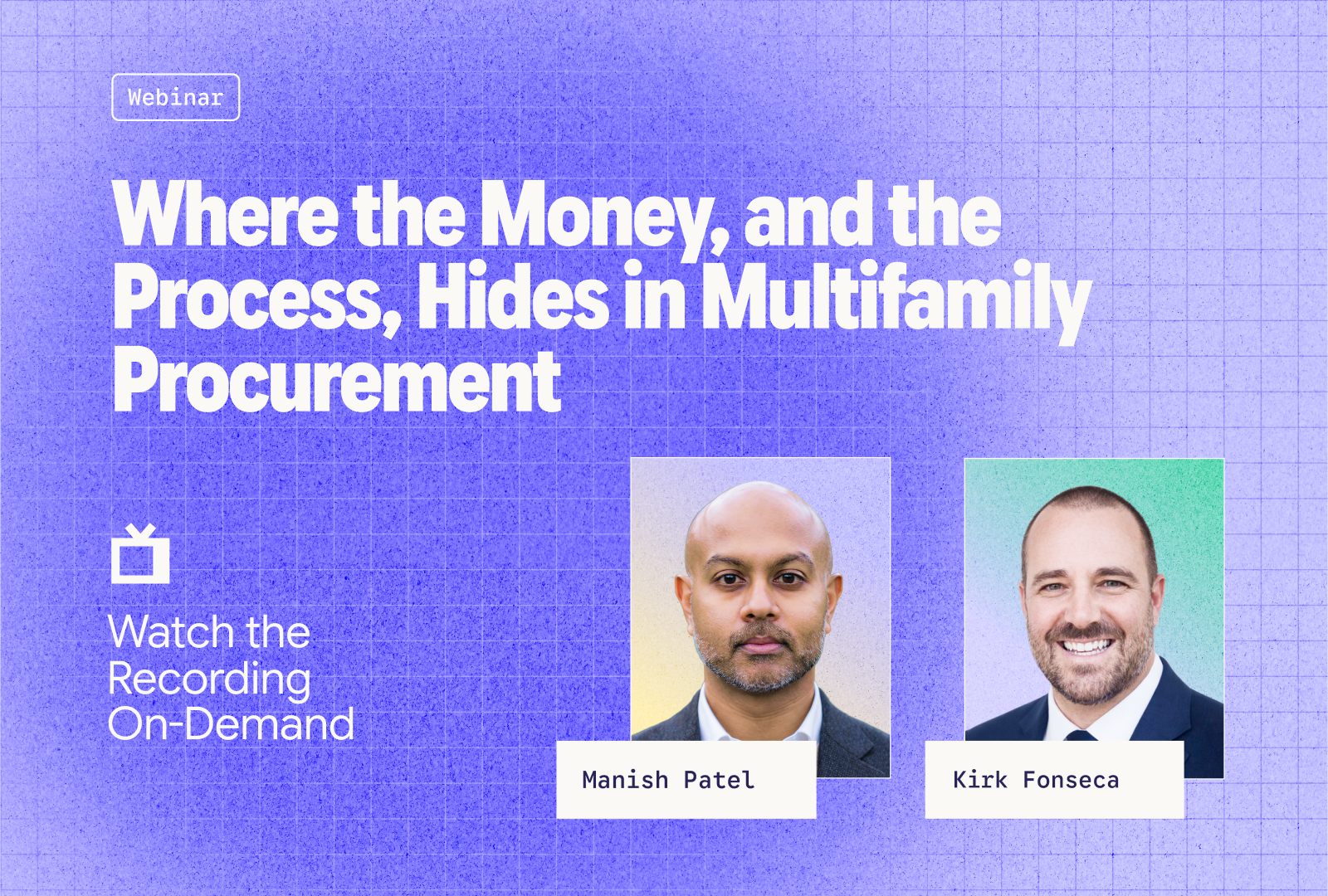
In a recent conversation with HappyCo's Head of Procurement, Manish Patel, and Kirk Fonseca, the former Director of Sourcing and Procurement at Essex Property Trust, they laid out exactly how that gap forms across a large portfolio, and what it takes to close it.
The Cost of Decentralized Buying
Before Essex built a centralized sourcing function, purchasing happened property by property. There were no standard scopes of work, no consistent contract management, and — most tellingly — no single person with visibility into who was buying what, from which vendor, at what price.
It was duplication: the same service, purchased from different vendors, inside the same property, in the same month. Multiply that across 270 properties and 60,000 units, and the inefficiency compounds fast.
This is the same fragmentation HappyCo has spoken about prior when looking at where procurement is headed — the industry default is still largely manual, and manual doesn't scale past a handful of properties before visibility breaks down.
Vendor Consolidation: The Easiest Savings on the Table
The fix Kirk pointed to first was vendor consolidation, with the numbers back it up. Regionally clustering properties and consolidating fragmented vendor relationships (eight landscaping vendors across a pod of properties, for example, reduced to one or two) typically delivers 8–20% in savings, simply by putting purchasing volume to work.
It's not a strategy that applies evenly to every category. Some — landscaping, pool service — consolidate cleanly to a primary and secondary vendor. Others need a curated pool of pre-negotiated vendors that site teams can tap into quickly, without a lengthy sourcing process for every job. Either way, the savings depend on someone actually watching the category — and most operators don't have the headcount to track all 18–20 major spend categories in multifamily on top of everything else on their plate.
Why “Invisible Spend” Is the Harder Problem
Savings from consolidation are the visible win. The harder problem is the spend nobody's tracking at all.
When purchase orders, AP data, and contracts live in disconnected systems, operators lose the ability to see where money is actually going. Kirk pointed to a compliance number that comes up again and again in multifamily: even with negotiated contracts and better pricing already in place, actual compliance often sits in the 60–70% range. Contracts exist. Teams still buy around them.
That's not a training problem — it's a design problem. If the compliant path isn't also the easiest path for a property manager juggling leasing, maintenance, and resident requests, they'll find a faster way around it. Fixing that requires the same thing HappyCo's Asset Management tools are built to provide at the capital planning level: real-time visibility that lets ownership and operations see spend and compliance clearly, instead of reconstructing it after the fact.
What Procurement 2.0 Actually Looks Like
Kirk's vision for rebuilding procurement from scratch centers on one idea: technology should enable site teams, not add a layer of complexity on top of their existing workload. He's watched enough new procurement tools get adopted for a month and then quietly abandoned to know that complexity is what kills adoption, not resistance to change.
The tools that stick are the ones that meet people where they already are — conversational, fast, and integrated into a single source-to-pay ecosystem rather than one more disconnected app. AI has a real role here: helping draft scopes of work in minutes instead of days, guiding bid comparisons, and mistake-proofing the purchasing process so the right vendor and the right price are the path of least resistance.
How Sourcing by HappyCo Addresses This
This is exactly the gap Sourcing by HappyCo was built to close. The platform brings bid management, vendor compliance, and spend analytics into one connected system:
- AI-driven bid management across 56 trade categories, generating a full statement of work from a short voice or text description and running the RFP process against a vetted vendor network.
- Vendor Connect, which centralizes vendor documentation and tracks compliance requirements like insurance and bonding automatically, rather than in a spreadsheet someone updates when they remember.
- Spend Advisory, which reviews invoices down to the line item to catch overspending, penalty fees, and contract deviations in categories like MRO and trash — turning invisible spend visible again.
Smarter Procurement Starts at HappyCo
For ownership groups watching NOI and portfolio performance, the throughline is the same one covered in HappyCo's guidance for owners and asset managers: spend visibility and compliance aren't back-office details. They're a direct lever on the bottom line.
Lauren Seagren is the Content Marketing Specialist at HappyCo, where she leads the company’s content strategy and storytelling across channels. She develops and optimizes campaigns, blogs, case studies, and enablement materials, while building the systems that help content scale and align across teams. Prior to HappyCo, Lauren led content and brand strategy across SaaS startups, creative agencies, and growth-stage companies, bringing more than a decade of experience driving measurable growth across B2B and B2C organizations.


